

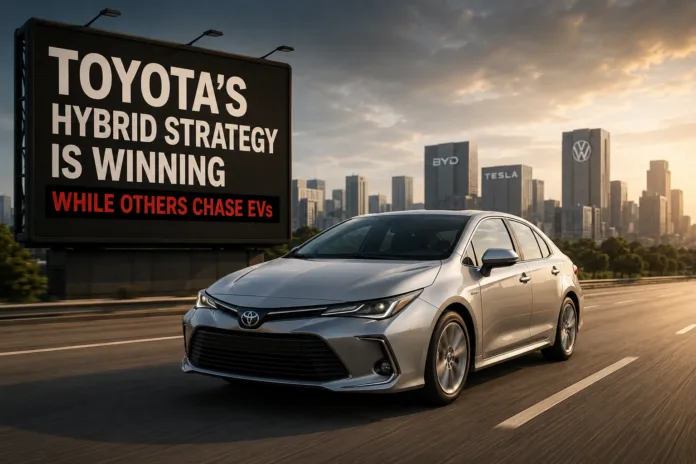
For years, Toyota faced criticism for not moving aggressively enough into the electric vehicle market.
While brands like Tesla, Volkswagen, Ford, General Motors, Hyundai, and BYD accelerated their electric vehicle programs, Toyota remained committed to hybrids, plug-in hybrids, hydrogen technology, and a diversified powertrain strategy.
Industry analysts, environmental groups, and even investors often questioned Toyota’s Hybrid Strategy, arguing that the company was moving too cautiously while rivals raced toward an all-electric future.
Many believed Toyota was falling behind in the EV race.
But as the global automotive industry enters a new phase, Toyota’s Hybrid Strategy is beginning to look far more calculated than many initially assumed.
Today, hybrid sales are booming worldwide, several automakers are slowing or delaying EV expansion plans, and consumers are increasingly looking for practical alternatives to fully electric vehicles.
The result?
Toyota’s Hybrid Strategy may have quietly positioned the company as one of the smartest and most resilient players in the global automotive industry.
The EV Race That Changed The Industry
The past decade has been defined by one major automotive trend: electrification.
Governments announced ambitious emission targets.
Countries proposed future bans on internal combustion engines.
Automakers committed billions of dollars toward electric vehicle development.
The automotive industry rapidly shifted from asking whether EVs were the future to assuming they would dominate the market within a few years.
Tesla became the symbol of this transformation.
Traditional manufacturers rushed to launch EV platforms, battery factories, charging partnerships, and new electric sub-brands.
Many companies treated EV adoption as an all-or-nothing transition.
Toyota did not.
Instead of betting everything on battery-electric vehicles, Toyota pursued what it calls a “multi-pathway approach.”
The company continued investing in:
- Hybrid vehicles
- Plug-in hybrid vehicles
- Battery-electric vehicles
- Hydrogen fuel-cell vehicles
- Alternative fuel technologies
At the time, many critics viewed this as hesitation.
Today, it looks increasingly like risk management.
Toyota Invented The Modern Hybrid Revolution
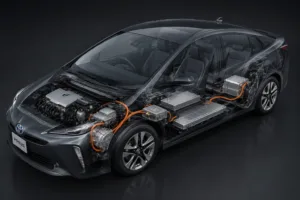
One reason Toyota remained confident in hybrids is simple:
It helped create the modern hybrid market.
When the Toyota Prius launched in 1997, few people believed hybrid technology would become mainstream.
The Prius eventually became one of the most influential vehicles in automotive history.
Over the following decades, Toyota refined hybrid systems, improved reliability, reduced costs, and expanded hybrid technology across its lineup.
The company sold millions of hybrid vehicles globally and established itself as the undisputed leader in hybrid technology.
While competitors focused on catching Tesla, Toyota continued improving a technology it already understood better than anyone else.
Why Consumers Are Choosing Hybrids Again
One of the biggest reasons Toyota’s strategy is paying off is changing consumer behavior.
Electric vehicles have achieved significant growth, but they still face several challenges:
Charging Infrastructure
Many buyers remain concerned about charging accessibility.
This is especially true in developing markets where charging networks are still expanding.
Vehicle Pricing
EVs remain more expensive than many traditional vehicles.
Although prices are gradually declining, affordability remains a barrier for mass-market adoption.
Range Anxiety
Consumers continue to worry about long-distance travel and charging availability.
Battery Costs
Battery production remains expensive and resource-intensive.
Hybrid vehicles solve many of these concerns.
Drivers receive improved fuel efficiency without changing driving habits.
There is no need to install chargers.
Long-distance travel remains convenient.
Fuel stations remain accessible.
As a result, hybrid sales have experienced strong growth across multiple global markets.
The 1:6:90 Philosophy
One of Toyota’s most discussed arguments revolves around battery resource allocation.
The company has often referenced what industry observers call the “1:6:90” concept.
According to Toyota’s reasoning, the raw materials required to build one long-range electric vehicle could instead be used to produce:
- One EV
- Six plug-in hybrids
- Ninety traditional hybrids
Toyota argues that spreading battery resources across more vehicles can potentially reduce emissions faster than concentrating those resources into fewer battery-electric vehicles.
Whether everyone agrees with this philosophy or not, it highlights Toyota’s broader approach:
Maximizing environmental impact through practicality rather than ideology.
Why Other Automakers Are Adjusting Their Plans
A few years ago, many manufacturers announced aggressive EV timelines.
Since then, market realities have forced adjustments.
Several automakers have:
- Delayed EV launches
- Reduced production targets
- Increased hybrid investment
- Extended internal combustion engine development
Some companies discovered that consumer adoption was progressing more slowly than expected.
Others struggled with profitability.
Battery production costs, supply chain pressures, and uncertain demand created new challenges.
Meanwhile, Toyota’s balanced portfolio allowed it to remain flexible.
Instead of depending entirely on EV demand, the company could adapt to changing market conditions.
That flexibility is becoming a major competitive advantage.
Toyota Is Not Anti-EV
One common misconception is that Toyota opposes electric vehicles.
That is not accurate.
Toyota continues investing heavily in EV development.
The company has announced new battery-electric models, expanded EV production plans, and invested billions in future technologies.
Toyota’s argument has never been that EVs are unnecessary.
Its argument is that different markets require different solutions.
A customer in Norway may have very different infrastructure access compared to a customer in India, Africa, South America, or Southeast Asia.
Toyota believes mobility solutions should reflect those differences.
This customer-first approach remains central to the company’s strategy.
Why Toyota’s Strategy Works In India
India provides a perfect example of Toyota’s thinking.
Although electric vehicle adoption is growing, several realities remain:
- Charging infrastructure is still developing
- Many consumers prioritize affordability
- Long-distance travel remains common
- Fuel efficiency strongly influences purchase decisions
For many Indian buyers, hybrid technology offers an attractive middle ground.
It provides improved fuel economy and lower emissions without requiring major lifestyle adjustments.
This is one reason hybrid demand is increasing across multiple segments.
Toyota’s experience with hybrid technology positions it strongly within this environment.
The Profitability Advantage
Another major factor often ignored in EV discussions is profitability.
Building profitable EVs remains difficult for many manufacturers.
Heavy battery costs, aggressive pricing competition, and large development investments continue affecting margins.
Toyota’s hybrid business, however, benefits from decades of engineering refinement.
The company already possesses extensive manufacturing experience, supplier relationships, and production efficiency.
As a result, Toyota can generate strong returns while continuing to expand its electrified lineup.
This financial stability gives Toyota more freedom than competitors facing pressure to rapidly scale EV production.
What The Future Looks Like
The future of mobility is unlikely to belong to a single technology.
Instead, the industry may evolve through multiple parallel solutions:
- Battery-electric vehicles
- Hybrid vehicles
- Plug-in hybrids
- Hydrogen fuel cells
- Synthetic fuels
- Alternative energy systems
Toyota appears to be preparing for exactly that scenario.
Rather than predicting a single winner, the company is building a portfolio capable of adapting to different market outcomes.
That strategy may not generate headlines as quickly as bold EV announcements.
However, it may generate something more important:
Long-term resilience.
Final Thoughts
For years, Toyota was criticized for moving too slowly toward electric vehicles.
Today, the conversation is changing.
As hybrid sales surge, EV adoption faces real-world challenges, and automakers reconsider their strategies, Toyota’s measured approach appears increasingly justified.
The company did not reject electrification.
It simply refused to believe there was only one path forward.
Whether EVs eventually dominate global transportation or coexist alongside hybrids and other technologies, Toyota has positioned itself to benefit from multiple possible futures.
In an industry obsessed with disruption, Toyota focused on flexibility.
And that decision may prove to be one of the smartest strategic moves in modern automotive history.
Conclusion
Toyota’s hybrid strategy demonstrates that innovation is not always about moving fastest.
Sometimes it is about moving smartest.
As the automotive industry navigates one of the biggest transformations in its history, Toyota’s commitment to hybrids, EVs, and multiple powertrain solutions may ultimately become the blueprint others wish they had followed.
For more automotive industry analysis, future mobility trends, vehicle technology updates, and in-depth automotive insights, stay connected with Torquexpert.
Also see-



