

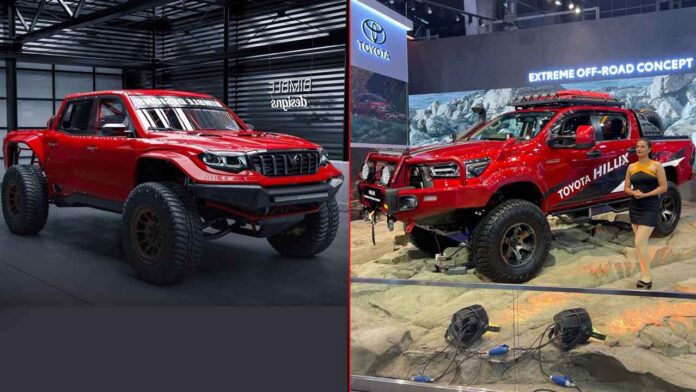
The battle for off-road dominance is undergoing an engineering shift, sparking a fierce debate between Hybrid vs Diesel Off Roaders. For decades, mechanical simplicity and high torque density made conventional turbodiesel engines the undisputed kings of low-range trails, heavy towing, and overland expeditions. However, mild-electrification is entering traditional four-by-four territory. Leading this new wave is the 48-volt mild-hybrid electric vehicle (MHEV) Toyota Hilux, which pairs a belt-driven motor-generator with Toyota’s 2.8-litre turbodiesel. Standing opposite this hybrid approach is the Mahindra Scorpio-N, utilizing a heavy-duty, unassisted 2.2-litre mHawk turbodiesel.
Choosing between these two off-roaders requires looking beyond brochure figures. Understanding how electric torque assistance alters rock crawling precision, heat dissipation during sustained hill climbs, payload towing performance, and long-term trail repairability reveals which platform truly holds the edge for serious enthusiasts.
Low-RPM Rock Crawling and Throttle Modulation
Navigating technical boulders, rutted washouts, and steep ledges requires predictable torque delivery at low engine speeds. In traditional diesel engines, a brief delay occurs while waiting for exhaust pressure to spool the turbocharger turbine. If a driver compensates by pushing the throttle too far, the sudden surge of boost can break tire traction over loose surfaces.
[ Hilux 48V MHEV ]  Electric Motor Assist (< 1,000 RPM) ---> Instant Torque ---> Reduced Idle (600 RPM)
[ Scorpio-N Diesel] Throttle Input ---> Exhaust Flow Spools Turbo ---> Power Onset (1,750 RPM)
The 48V Toyota Hilux addresses turbo lag by placing a compact electric motor-generator directly on the engine accessory belt system. This electric motor supplies an immediate supplementary push of up to 65 Newton-meters of torque directly to the crankshaft at off-the-line acceleration and speeds below 1,000 RPM. By utilizing electric torque to fill the low-end gap before the primary turbo spools, the Hilux allows its engine idle speed in low-range (L4) to drop from 720 RPM down to 600 RPM. This lower idle speed provides smooth, predictable crawling capability, letting the driver feather the accelerator over sharp rock steps without wheel spin.
The Mahindra Scorpio-N relies on a traditional variable-geometry turbocharger (VGT) setup. Its 2.2-litre mHawk diesel produces 400 Newton-meters of torque between 1,750 and 2,750 RPM in its 6-speed automatic 4XPLOR configuration. While this provides strong mid-range punch, off-idle power below 1,500 RPM depends entirely on mechanical gear reduction and torque converter stall speeds. When climbing technical trails, the driver must carefully manage the transition as boost builds, making the Scorpio-N slightly more reliant on brake-throttling techniques compared to the electric-assisted Hilux.
Thermal Resistance and Cooling Under Continuous Load

Off-road environments subject engines to extreme thermal stress. Deep sand driving, heavy mud bogging, and long mountain pass climbs generate massive internal heat while vehicle forward speed remains low, drastically reducing airflow through the front radiator stack.
The Mahindra Scorpio-N excels in straightforward thermal management due to its simpler cooling layout. Its mechanical cooling system centers around a high-capacity radiator, a large air-to-air intercooler, and a robust mechanical engine fan coupled with electronic auxiliary fans. Because the mHawk diesel relies strictly on diesel fuel combustion without auxiliary battery packs or DC-DC converters, heat generation remains localized within the engine block, exhaust manifold, and transmission fluid lines. Under sustained high-load mountain climbs, tracking coolant and oil temperatures remains predictable, allowing tuners to set clear safety margins for fuel-rail pressure and boost limits.
In contrast, the 48V Hilux manages a dual-thermal load. Alongside cooling the internal combustion engine and water-cooled intercooler, the system must keep the 48-volt lithium-ion battery package and DC-DC converter within safe operating temperature windows. Housed beneath the rear seats, the battery draws cooling air from inside the cabin via a dedicated dust-filtered intake.
During prolonged low-speed rock crawls under extreme ambient heat, if cabin temperatures rise or dust clogs the battery filter, the hybrid system’s ECU may throttle back electric assist to protect the lithium cells from heat degradation. However, under normal operating conditions, the MHEV system actually lowers overall engine thermal strain by reducing the diesel engine’s load during low-efficiency running.
+------------------------------------------------------------------------------------+
|                   THERMAL & POWER METRICS COMPARISON                               |
+------------------------------------------------------------------------------------+
| Metric                        | Toyota Hilux 48V MHEV  | Mahindra Scorpio-N 4WD    |
+-------------------------------+------------------------+---------------------------+
| Displacement / Engine Type    | 2.8L 4-Cyl Turbodiesel | 2.2L 4-Cyl Turbodiesel    |
| Base Output (HP / Torque)     | 204 HP / 500 Nm        | 175 HP / 400 Nm           |
| Low-RPM Assist                | +12 kW / +65 Nm Elec.  | Pure Mechanical VGT       |
| Low-Range Engine Idle Speed   | 600 RPM                | ~750 RPM                  |
| Primary Thermal Load Area     | Engine + 48V Battery   | Engine Block / Intercooler|
+------------------------------------------------------------------------------------+
Payload Towing, Gearing, and Highway Torque
When expanding an off-roader into a full overland vehicle, payload capacity and towing performance become critical parameters. Heavy steel bumpers, roof racks, recovery gear, and dual-axle off-road trailers demand consistent torque across broad gear ranges.
The Toyota Hilux maintains a clear advantage in raw hauling capacity. Its 2.8-litre platform generates 204 DIN horsepower and 500 Newton-meters of torque between 1,600 and 2,800 RPM. Paired with its heavy-duty leaf-spring rear suspension layout, the Hilux delivers a payload capacity exceeding 1,000 kilograms and a braked towing capacity of 3,500 kilograms. When pulling a heavy trailer up an highway incline, the 48V motor-generator assists during gear upshifts, bridging power gaps between gear changes to maintain momentum.
The Mahindra Scorpio-N uses a Watts-link rear suspension with frequency-dependent dampers. While this coil-sprung architecture offers superior ride comfort on corrugated gravel roads, it trades off maximum payload headroom compared to the Hilux’s commercial leaf springs. Delivering 175 horsepower and 400 Newton-meters of torque, the Scorpio-N easily hauls medium overland gear setups. However, under heavy trailer loads on steep grades, the 2.2-litre engine must downshift more frequently to keep revs inside its peak power band.
Long-Term Maintenance, Trail Repairs, and Reliability

Out in remote wilderness regions, mechanical simplicity often trumps high-tech sophistication. When a component fails hundreds of miles from the nearest service station, the ability to diagnose and repair the vehicle with standard tools is invaluable.
This is where the traditional diesel design of the Mahindra Scorpio-N shines. Containing no high-voltage wiring, lithium-ion packs, or auxiliary belt-driven generators, its mechanical components are familiar to general mechanics. Replacing an alternator, servicing the serpentine belt, or replacing shock absorbers requires minimal specialized equipment, making long-distance overland travel less reliant on complex diagnostic tools.
The 48V Toyota Hilux adds extra layers of electronic integration. Toyota engineered the system for durability: the 48V motor-generator sits high in the engine bay to retain its 700 millimeter water-wading depth, and the belt mechanism uses a reinforced two-arm tensioner designed for muddy environments.
However, introducing a lithium-ion battery pack, a DC-DC converter, and integrated regenerative braking systems adds potential failure points. If an electronic sensor fault triggers a hybrid system shutdown, the vehicle may enter a reduced-power limp mode, requiring specialized OBD diagnostic software to clear faults and re-calibrate sensors.
Final Verdict: Which Off-Road Philosophy Wins?
The choice between these two vehicles comes down to how you plan to use them:
-
Choose the Toyota Hilux 48V Hybrid if you want maximum towing capacity, precise low-speed rock crawling control, and smoother torque delivery. The mild-hybrid electric assist turns a heavy-duty pickup truck into a more refined, low-speed trail vehicle without sacrificing load capability.
-
Choose the Mahindra Scorpio-N Diesel if you prefer a traditional 4×4 platform with simpler mechanical components, lower long-term maintenance costs, and exceptional ride comfort over long gravel trails.
Electrified torque fill is proving to be a legitimate tool for off-road driving, but pure turbodiesel power remains a dependable option for traditional enthusiasts.
Follow us on instagram @torquexpert to get daily updates .
Also see-



